Services / Paint Protection Film (PPF)
Paint Protection Film (PPF) in Fargo, ND
Invisible armor for your paint against chips, salt & scratches
Typical time in shop: 1–3 days · Free custom quote
 Paint Protection Film (PPF)
 Fargo, ND · Paint Protection Film (PPF)
Look at the leading edge of the hood on any three-year-old truck that commutes on I-29. The chips start small and cluster toward the middle, where the tire in front of you throws whatever it picked up off the shoulder. By year five the leading edge has gone from chipped to pitted, and a few of those chips have opened down to primer and started to rust from the inside out. That specific pattern of damage is what paint protection film exists to stop.
PPF is a clear urethane layer installed directly over your factory paint. It is not a spray or a coating. It is a physical film with real thickness, computer-cut to your vehicle's panels and wrapped around the edges so there is nothing for a pressure washer to catch. It takes the hit so the paint underneath doesn't, and it does that without changing the color or gloss of the car.
It will not save your bumper in a collision and it is not a substitute for leaving space in front of you on a gravel road. What it absorbs is the daily grind: rock chips, road grit, brine, bug etching and the light scuffs that come from parking lots.
Why it’s worth it
What you get
- Rock chip protection on the panels that take the hits, which is the front bumper, the hood, the mirrors and the leading edge of each fender
- Self-healing urethane, so light scratches and swirls in the film relax back out when it's warmed by sun or a heat gun
- Optically clear, so your paint color and gloss come through unchanged instead of sitting under a visible sheen
- A barrier against brine and de-icing chemicals that would otherwise sit directly against bare clear coat all winter
- Computer-cut patterns for your exact year, make and model, edge-wrapped so there are no visible film lines and nothing to lift
- Gloss or satin film options, if you want the protection to change the look of the vehicle as well as protect it
How it works
Our process
We recommend partial, full-front or full-body based on how and where you drive.
The paint is washed, clayed and prepped so the film bonds perfectly.
Patterns are plotted per panel and hand-wrapped around edges for a clean, tuck finish.
We inspect every edge and give you the warranty and wash guidance.
What we do
Our paint protection film process, in detail
The first conversation is about how you drive. Someone running the interstate to West Fargo twice a day has a completely different exposure profile than someone who mostly drives in town, and that difference decides coverage level more than anything else does. We quote partial front, full front and full body, and we'll tell you when the smaller package is the right answer for your situation.
All film is installed from precision computer-cut patterns matched to your specific vehicle rather than hand-trimmed on the car, which is how you get clean panel lines and properly wrapped edges instead of film that stops short and starts lifting in a year.
- Partial-front coverage, covering the hood edge, front bumper, mirrors and fender leading edges
- Full-front coverage, taking in the full hood, full bumper, full fenders, mirrors and headlights. This is the most common choice for highway commuters
- Full-body coverage for owners who want the entire exterior protected
- Edge-wrapped, computer-cut installation for a finish with no exposed film edges
- Gloss or satin film, depending on the look you want
- The film manufacturer's own warranty, whose terms we'll go over with you before you commit
- Optional ceramic coating applied over the film for added slickness and easier washing
Who it’s for
Which vehicles benefit most
New vehicle owners
The best moment to protect a vehicle is before its first winter. New paint is at its softest during the first year, and the first brine season is usually when the most damage lands, simply because nothing was covering the clear coat yet. We see a lot of new trucks come in within a week of purchase for exactly that reason.
Highway commuters
Any regular stretch of I-29 or I-94 means accumulating chip exposure on every trip. The front end takes a steady low-grade sandblasting from gravel and sand thrown by traffic, and over a few winters that is the difference between a hood full of chips and paint that still looks new.
Trucks and adventure vehicles
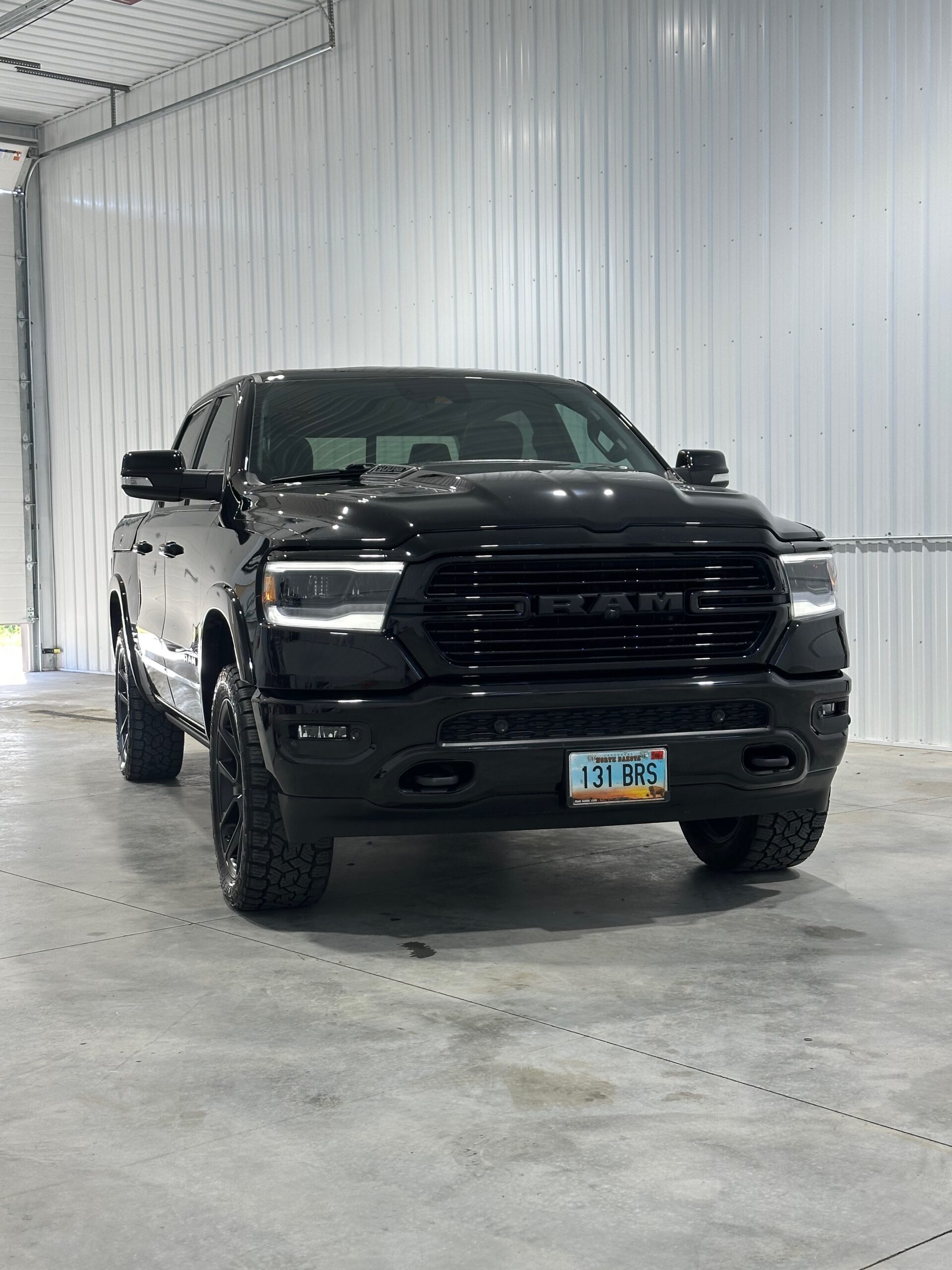
Gravel roads, farm access, lake trips and off-pavement driving hit harder and more often than commuting does, and they hit places a commuter car never gets touched. Full-front or full-body coverage on these vehicles is matching the protection to the environment rather than overspending.
Resale-focused owners
If you plan to sell or trade in a few years, film keeps the paint free of the chips and etching that quietly pull a vehicle's appraisal down. Paint that has been shielded simply presents better, and the film can be removed by a professional when the car changes hands.
Good to know
Why paint protection film makes sense for a North Dakota winter
North Dakota does not give paint an easy life. Sand and gravel come off open shoulders on the interstate, brine goes down ahead of every storm, and a Fargo-Moorhead winter puts a vehicle through more freeze-thaw cycles than most of the country sees. Rock chips are the visible damage. The quieter problem is what happens after a chip opens: brine and de-icing chemicals reach bare metal at the chip site and at seams, and corrosion starts there and works outward. Film covering the front end means the impact lands on urethane instead of opening a path to the metal.
People ask whether sub-zero cold hurts how the film performs, and it's a fair question. Self-healing relies on heat. Warm sun, a warm garage or a heat gun makes the top layer relax and pull light scratches back out. In a January cold snap that process slows down, so a light mark can sit visible for weeks. It hasn't failed, it's waiting. The first warm day, or a few minutes with a heat gun, brings it back. The film itself stays flexible and adhered through the cold.
The other constant question is film versus ceramic coating, and the honest answer is that they solve unrelated problems. Coating is a chemical layer. It bonds to the paint, makes it hydrophobic, and makes washing and bug removal much easier. It does not stop a rock chip. It is hard, but it is a fraction of the thickness of film, and gravel at seventy miles an hour goes straight through it. Film is a physical layer with real depth, engineered to absorb that energy.
Which is why a lot of owners do both. Film goes on the impact zones first, then coating goes over the film and the rest of the vehicle. You end up with impact resistance where the impacts happen and easy maintenance everywhere. If you're deciding where to start, a new vehicle or a daily highway commuter gets the clearest return from full-front coverage. A car that mostly stays in town is often better served by partial coverage or by coating alone, and we'll say so.
FAQ
Paint Protection Film (PPF) questions, answered
Will paint protection film stop every rock chip?
No film is completely chip-proof. What PPF does very effectively is absorb the energy of most everyday rock and gravel impacts, either preventing a chip entirely or keeping the damage in the film instead of your paint. A large piece of debris at highway speed can still leave a mark on the film, but that's film we can replace rather than paint you have to live with. It's a large reduction in real-world damage, not an absolute.
Does the film turn yellow or hazy over time?
Yellowing was largely a problem with older, lower-grade films. Current urethane films are engineered to stay optically clear, and regular washing plus staying away from harsh solvent cleaners is most of what keeps them that way. If you see yellowing or clouding well inside the film's expected life, that's worth bringing back to us to inspect against the manufacturer's warranty.
How does the self-healing property actually work?
The film has an elastomeric top layer that flexes and returns to its original shape when warmed, whether from sunlight, a warm garage or a heat gun. Light scratches and scuffs smooth back out as it recovers. It's fastest in summer. In winter it can take considerably longer, or a deliberate application of heat.
Can I get paint protection film and ceramic coating together?
Yes, and it's one of the most common combinations we install. Film goes on the high-impact panels for physical protection, then coating goes over the film and the rest of the vehicle for chemical resistance and easier washing. They target different problems, so they stack rather than overlap.
How long does installation take and how soon can I drive it?
That depends on the coverage level, and we'll give you a specific window once we've seen the vehicle. You can generally drive right away. What matters is the short curing period before washing or heavy moisture exposure, and we'll walk you through that before you leave.
Can film be removed later without damaging my paint?
Removal by someone who does it regularly, using controlled heat, is normally clean on healthy factory paint. Where it gets risky is film left on well past its life, or paint that has already been repainted or has adhesion problems underneath. If a panel has been resprayed, tell us before installation so we can factor it in.
Should I get PPF on a vehicle that already has chips in the hood?
Film goes over what's there, so it protects the paint from here forward rather than fixing existing damage, and it will make existing chips slightly more visible under the clear layer. If the chips bother you, the honest sequence is touch-up or paintwork first, then film. We'll look at the hood with you and tell you whether it's worth doing that first.
Book your paint protection film
Serving Fargo, ND, West Fargo, ND, Moorhead, MN, Dilworth, MN and the surrounding area.
Get a free quote