Services / Paint Correction
Paint Correction in Fargo, ND
Bring back the gloss winter washing wore away
Typical time in shop: 1–3 days · Free custom quote
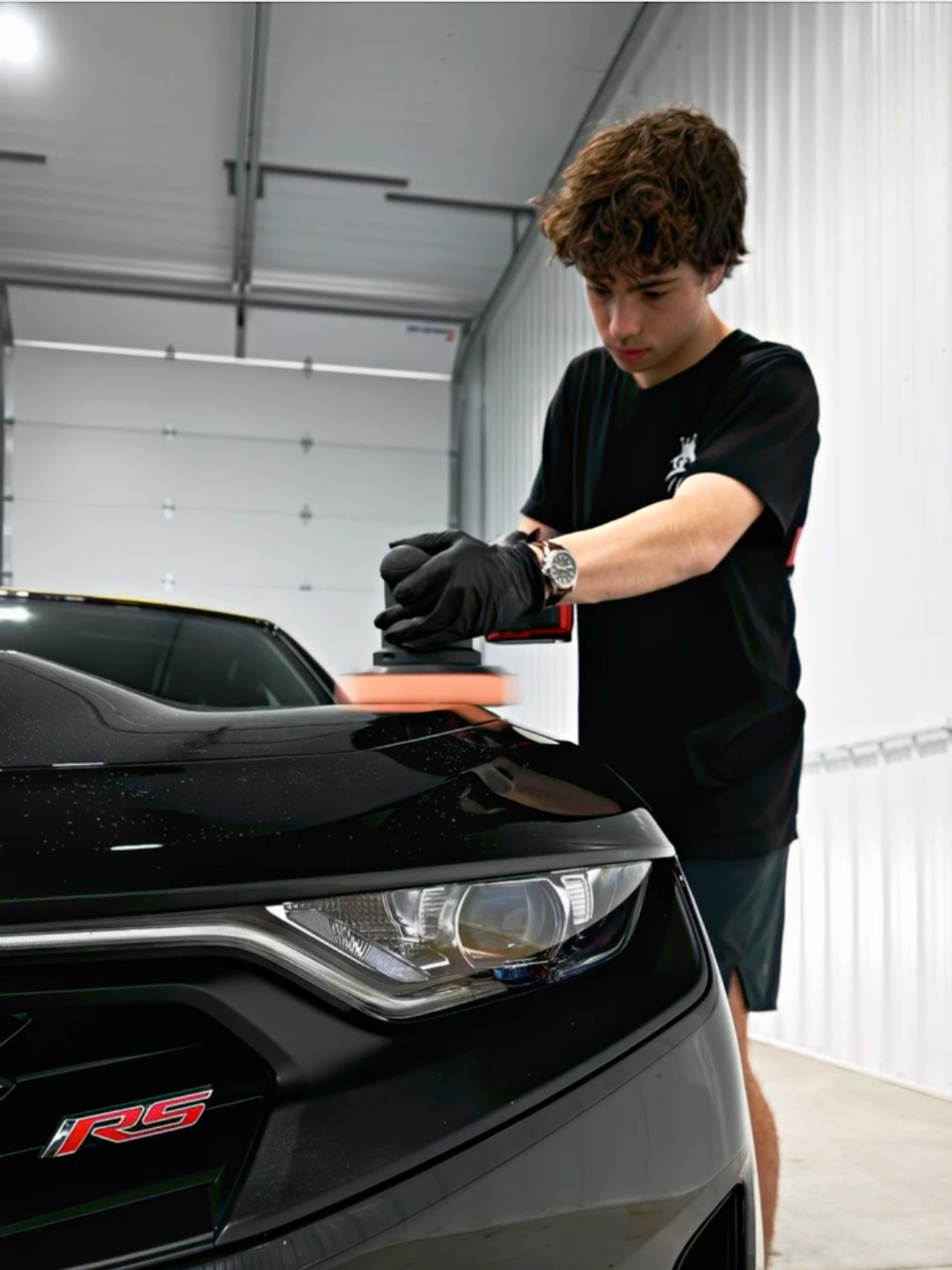 Paint Correction
 Fargo, ND · Paint Correction
Park a black car under a shop light and you can read its whole history in about ten seconds. The circular haze across the hood came from an automatic wash. The straight lines on the trunk lid came from someone wiping road film off with a dry towel. The dull grey cast on the roof and upper fenders is oxidation from sun. None of it is dirt, and none of it washes off.
Paint correction is machine polishing that levels the top of your clear coat until those defects are physically gone. Your clear coat is covered in thousands of microscopic scratches that scatter light in every direction, and scattered light reads to your eye as haze. Take the surface down to level and light reflects cleanly again.
Which means the gloss is not added. It is uncovered. It was under there the whole time.
Two things to know before you book. Correction removes material, so it is not something a car can go through indefinitely. And it does not undo everything. A scratch that has cut through the clear coat into the color underneath has no clear coat left to level, and no amount of polishing brings that back.
Why it’s worth it
What you get
- Removes swirl marks and spider-webbing from automatic washes, dry wiping and improper wash technique
- Removes holograms and buffer trails left by a previous rotary job or a rushed detail
- Levels the clear coat instead of filling it, so the result is still there after the next few washes
- Reduces water spot etching and mineral staining from hard water and sprinkler overspray
- Cuts through sun-driven oxidation, which is what puts the chalky, flat cast on horizontal panels after a few summers
- Gives a ceramic coating something worth locking in, since a coating preserves whatever condition the paint is in when it goes on
How it works
Our process
We measure paint, assess defects under correction lighting, and set realistic goals with you.
Wash, clay and prep so we’re polishing clean paint, not grinding grit into it.
Machine polishing in stages to remove swirls, scratches and oxidation safely.
We recommend sealing the work in with a ceramic coating so the finish lasts.
What we do
Our paint correction process, in detail
Correction is a range, not a fixed service, and matching the level to the paint is most of the job. Before a pad touches the car we inspect it under dedicated lighting to see how deep the swirls run and how much clear coat we are working with. That decides whether you need a single-stage enhancement or a multi-stage correction, and we have that conversation before you commit rather than after.
From there the work is methodical and panel by panel, with inspection passes to confirm defects are actually leaving rather than being pushed around. A typical service includes:
- Decontamination wash and iron fallout removal before any polishing
- Clay bar or chemical decontamination until the surface is completely smooth
- Paint depth measurement where it matters, to understand what we have to work with
- Machine polishing in one or more stages using cutting and finishing compounds matched to the paint's condition
- Panel-by-panel inspection under dedicated lighting between stages
- A final finishing pass for maximum clarity before protection goes on
- A rundown of what was corrected, what remains, and what protection makes sense next
Who it’s for
Which vehicles benefit most
New-to-you used cars
Buying a used vehicle means inheriting someone else's wash habits. Even a well-kept car usually arrives with years of accumulated swirling and water spots that nobody had control over. Correction strips that history out of the clear coat, and it is often the single thing that makes a used car finally feel like yours rather than the last owner's.
Swirl-heavy daily drivers
If your car goes through automatic washes and gets wiped down with whatever towel is in the garage, swirl marks are essentially guaranteed. That is not a comment on how you care for it. It is what happens to paint that gets used. These vehicles produce the most dramatic before-and-after we see, because leveling all that fine scratching brings back depth the owner had forgotten the car ever had.
Show and enthusiast cars
On a car you actually care about, correction is where the difference lives. This is the level where we are chasing holograms, fine finishing marks and the last bit of haze standing between good paint and paint that holds up under direct light with someone's face six inches from the fender. It is slower work and it is priced accordingly.
Good to know
What correction can and can't fix, and why it comes before a coating
Start with the physical reality. Your clear coat is not smooth, even on a car that looks clean. It is covered in microscopic scratches and inconsistencies that send light off in every direction rather than reflecting it back. That scattering is what your eye reads as haze, dullness, or the flat look paint takes on after a few years on the road. Machine polishing takes the peaks of that surface down until it is level and consistent, and light behaves properly again.
Not every car needs the same amount of work to get there, which is why we quote enhancement and full correction as different jobs. An enhancement is a single-stage polish. It removes light swirling and adds gloss in one pass, and on a newer or well-kept vehicle it is often all that's warranted. Less aggressive, less clear coat removed, less time. A full correction is a different animal: a cutting stage to remove deeper defects, then one or more finishing stages to refine clarity, with inspection between them. Heavily swirled daily drivers, sun-baked paint and used cars with unknown history usually need the fuller version.
Now the part that sets expectations. Every polishing pass removes a small, controlled amount of clear coat. That removal is exactly what levels the surface, and it is also why correction is finite. A factory clear coat only has so much thickness across the life of the vehicle. So we polish conservatively, we measure where measurement matters, and we do not recommend a heavier correction than the defects call for.
There is a hard limit too. Run a fingernail across a scratch. If it catches, that scratch has gone through the clear coat into the base color or the primer, and there is no clear coat left in that groove to level down to. We can often soften how visible it is. We cannot make it disappear, and we'll tell you which category yours falls into during the inspection.
All of this is why correction comes before a ceramic coating rather than instead of it. A coating cures into a hard, glossy layer over whatever the paint looks like the moment it is applied. It preserves that condition for years. Coat over swirls and you have sealed swirls under gloss. Correct first, and the coating is protecting genuinely good paint, which is where that deep, wet-looking clarity people associate with coatings actually comes from.
FAQ
Paint Correction questions, answered
Will paint correction remove all my scratches?
It depends how deep they go. Correction removes swirl marks, light scratches, water spots and haze that sit within the clear coat, which covers most of what makes paint look tired. Scratches that cut through the clear into the base color can't be polished out, because there's no clear coat left there to level. If your fingernail catches in a scratch, that's usually the deep kind.
What's the difference between an enhancement and a full correction?
An enhancement is a single-stage polish that removes light swirling and boosts gloss. It suits newer or well-maintained paint. A full correction uses multiple stages, typically a cutting step followed by finishing steps, to work through heavier swirling, oxidation or years of wash marring. We inspect first and recommend whichever level the paint actually calls for.
Can I get paint correction done as many times as I want?
No. Every correction removes a thin layer of clear coat, and clear coat is a finite resource over the life of a vehicle. We polish conservatively and check depth where it matters, but this isn't something to repeat every year.
Do I need paint correction before ceramic coating?
We strongly recommend it and in most cases it's the difference between a good result and a disappointing one. A coating seals in the paint's current condition. It doesn't remove swirls, it locks them under a glossy layer for years. Correcting first is what produces the clarity people expect from a coated car.
How long does paint correction last?
The correction itself is permanent, because the defects are physically gone rather than covered. What isn't permanent is staying swirl-free, since normal washing and driving gradually reintroduce marring. Pairing correction with a coating and better wash habits is what stretches the result out.
Is paint correction worth it on an older or used vehicle?
Frequently it's where we see the biggest change, since older paint carries the most accumulated history. The exception is paint that's already thin from age or previous over-polishing. That's exactly why we inspect and measure before recommending a level, and occasionally why we recommend against correction entirely.
My car is brand new. Does it need correction?
Sometimes, and it surprises people. Transport damage, dealer lot washes and dealer-applied prep can all leave marring on a car with delivery miles on it. It's usually light and a single-stage enhancement handles it. If your new car is genuinely clean under the lights, we'll say so.
Do you use a rotary or a dual-action polisher?
Both have a place, and the choice depends on the paint and the defects. Dual-action polishing is safer on thin or soft clear coats and finishes down beautifully. A rotary cuts faster on hard, heavily oxidized paint but leaves holograms if it's the last step, so it gets followed by finishing passes. Buffer trails on a car we've corrected mean we didn't finish the job.
Can you correct a wrapped or PPF-covered panel?
Paint protection film has its own self-healing top layer and responds differently to polishing than clear coat, so it needs a lighter, film-specific approach rather than standard compounds. Vinyl wrap generally shouldn't be machine polished at all. Tell us up front what's on the vehicle so we plan around it.
Book your paint correction
Serving Fargo, ND, West Fargo, ND, Moorhead, MN, Dilworth, MN and the surrounding area.
Get a free quote